
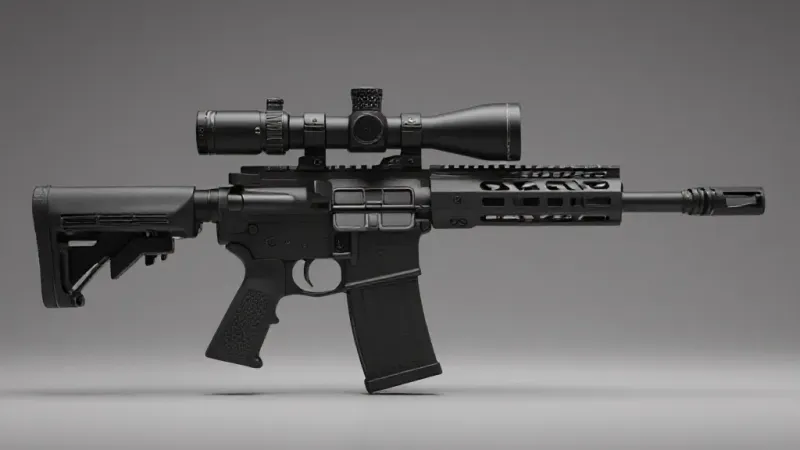
The M24 Sniper Weapon System (SWS) has served the US Army and various foreign militaries for over three and a half decades since its introduction in 1988. Despite its proven track record, the original design has been recognized as dated. Past efforts by the US Army to update the M24, such as the XM24A1, M24A2, M24A3, and the 2010 M24E1, primarily involved cartridge upgrades—to .300 Winchester Magnum or .338 Lapua Magnum—with only the M24E1 integrating a chassis system.
In 2019, the Israeli Defense Force (IDF) pursued a distinct modernization pathway for its M24 inventory, collaborating with MDT. This initiative, known as the IDF Modernized M24 SWS, focused on three core upgrades: replacing the original fiberglass stock with an MDT chassis, upgrading the optic and its mount, and adding a muzzle brake. While specifics on the muzzle brake and the Leupold scope selected by the IDF remain undisclosed, observations of actual service rifles, as documented by Zach Evenor, suggest that a gunsmith or armorer reset and re-chambered the barrels as part of this process, indicated by the orientation of caliber markings.
The strategic shift to a modern chassis system addresses the evolving demands of precision rifle engagements, particularly in night operations and dynamic, improvised field positions. Unlike the legacy fiberglass stock, the MDT chassis facilitates the seamless integration of contemporary accessories, including night vision optics, lasers, and illuminators. It also introduces the critical functional advantage of a detachable magazine system and a heavy-duty folding stock, paired with extensive adjustability to accommodate a diverse range of shooters.
The MDT chassis itself is described as robust, designed for rigorous duty. Its fore-end and dedicated night vision rail are notably sturdy, with the rail securing to the fore-end via four large screws and utilizing alignment pins for precise attachment. MLOK slots on the sides of the rail further expand mounting options for ancillary equipment. The chassis also incorporates ergonomic enhancements such as an ambidextrous, removable thumb shelf, designed to support various shooting styles. The trigger guard is generously wide, allowing for gloved operation, and features a drainage slot to prevent accumulation of water and debris. The folding stock mechanism is engineered to fold against the bolt handle side, minimizing the rifle's overall width when stowed.
Adjustability is a cornerstone of the modernized system, with the stock offering settings for length-of-pull, cheekpiece height, and butt plate position. The cheekpiece also features side-to-side adjustment, crucial for maintaining a consistent stock weld when utilizing larger or more complex optical systems. The adoption of AICS-style box magazines is reported to improve feeding reliability over the internal box magazines of the original M24. An oversized rubber pistol grip, provided by MDT, is noted for its comfortable and secure hand-filling profile, contributing to the reported ease with which the rifle settles into position once adjusted.
The chassis is reported to facilitate improved accuracy, with one instance noting a 5-round group at 100 yards with Federal Gold Medal Ammunition measuring .497 inches (.475 MOA). Further load development with 175-grain SMK projectiles was reported to achieve a .209-inch (.200 MOA) 100-yard group. This outcome suggests that the chassis upgrade, by providing a more stable and adjustable platform, significantly contributes to the system's precision potential without requiring a complete overhaul of the weapon system.
Overall, the IDF's modernized M24 program is presented as a successful endeavor to update a foundational sniper rifle. By focusing on a new chassis, enhanced ergonomics, and compatibility with modern optics and accessories, the initiative has extended the operational relevance of the M24, demonstrating a viable path to bring legacy systems into the current era of precision rifle shooting.