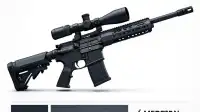

The Remington M24 Sniper Weapon System (SWS), deployed by the US Army in 1988, established a significant benchmark in military precision rifles. Built on a robust Remington 700 long action, the M24 was mass-produced by Remington, distinguishing it from the hand-built Marine Corps M40 series rifles. While chambered in 7.62 NATO (effectively .308 Winchester), its long action was designed to facilitate future upgrades to larger cartridges, such as .300 Winchester Magnum.
Key specifications of the M24 include a 24-inch stainless steel barrel with a 1:11.25-inch twist, a profile identical to the M40A3/A5/A6 series, albeit with a slightly shorter length. The rifle was issued with a fixed 10X Leupold scope and a unique provision for backup iron sights, a feature less common in modern sniper rifle configurations. Its barreled action feeds from an internal box magazine with a hinged floor plate, all housed within a Kevlar/Fiberglass HS Precision stock featuring an aluminum bedding block and an adjustable butt plate. This stock design, reminiscent of varmint stocks of its era, provides solid utility, though McMillan A2/3/5 series stocks are often noted for superior ergonomics.
Initial range impressions of a used M24 SWS, featuring an unknown round count, reveal insights into its performance. One shooter reported a notable five-round group of .725 MOA at 100 yards using Federal Gold Medal 175-grain factory ammunition. This group included a cold bore shot, with the subsequent four rounds reportedly grouping under .5 MOA. The rifle's trigger pull was observed to be just over five pounds, and the perceived recoil was noted as more pronounced than many contemporary .308 Winchester platforms, an observation that underscores advancements in modern rifle design and componentry.
Reflecting on the M24's legacy, its design offers a compelling comparison to current precision rifle trends. Modern platforms commonly integrate chassis systems, higher magnification optics, and forward rails for night vision devices, a significant evolution from the M24's simpler, yet highly effective, architecture. Upgrading an M24, particularly one based on a long action, requires specialized parts. However, demand from military users, including programs like the IDF Modernization for the M24, continues to drive innovation in available components. The M24 remains a testament to the foundational principles of precision shooting, offering a profound connection to the sport's roots and the significant progress of the industry.