For competitive long-range precision rifle shooters, the interplay between rifle, optic, and ammunition is paramount. While military sniper systems like the M24 are renowned for their sub-MOA precision with specialized match ammunition, the question of their performance with standard ball ammunition—such as the ubiquitous M80—often arises, particularly in discussions of emergency resupply scenarios.
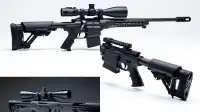
A recent examination focused on precisely this query, using a used M24 Sniper Rifle equipped with a fixed 10X scope. As a baseline, the rifle’s accuracy with Federal Gold Medal 175 Grain SMK match ammunition was noted to be excellent, consistently delivering groups well under 1 MOA with factory loads and approximately 0.5 MOA with handloads in five-shot strings at 100 yards.
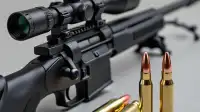
The core of the investigation involved testing the M24 with Winchester 147 grain full metal jacket M80 ammunition, a common military ball cartridge. After ten rounds fired at 100 yards, the reported accuracy was 2.572 MOA. The M80 ammunition yielded an average muzzle velocity of 2,803 feet per second, with a standard deviation (SD) of 17.8. This velocity figure was notably close, within 3 feet per second, of the military’s specified velocity for M80.
While a degradation in accuracy was anticipated, the reported severity of the shift to 2.5 MOA from sub-MOA match performance is a significant takeaway for precision shooters. Further ballistic analysis, comparing the M80 147gr FMJ (at 2,803 ft/s) against 175gr SMK (2,600 ft/s) and 168gr SMK (2,756 ft/s) rounds, highlighted key differences. Although the lighter M80 round’s higher velocity contributed to similar bullet drop profiles compared to heavier match loads out to 1,000 yards, its performance in wind was markedly inferior to the more aerodynamically efficient match projectiles. This underscores the critical importance of high ballistic coefficient (BC) projectiles in adverse wind conditions.
For PRS and NRL competitors, these findings reinforce the imperative of employing match-grade ammunition tuned to their specific rifle systems. While 2.5 MOA might suffice for less demanding applications or dire emergencies, it falls well short of the precision required for consistent hits on small targets at extended ranges under tight par times. The reported performance of M80 ball in the M24 serves as a practical illustration of the compromises inherent when moving away from purpose-built precision loads.