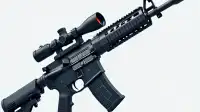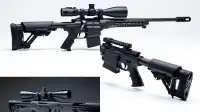

For precision rifle competitors and enthusiasts, the performance of specialized platforms with their intended match-grade ammunition is a familiar topic. Less frequently explored, however, are the capabilities of these systems when pressed into service with more common, standard ball ammunition—a scenario primarily relevant in emergency resupply situations. A recent assessment involving a used M24 Sniper Weapon System has provided insight into this query, focusing on its accuracy with M80 Winchester 147 grain full metal jacket ammunition.
The M24 rifle used for this assessment featured a fixed 10X scope. Its baseline performance with match ammunition was reported as excellent. Specifically, when firing Federal Gold Medal 175 Grain SMK ammunition, the rifle consistently achieved groups well under 1 MOA with factory loads and approximately 0.5 MOA with hand loads, based on 5-shot groups at 100 yards. This established the rifle's inherent precision and its capability with high-quality ammunition.
For the evaluation of standard ball performance, M80 Winchester 147 grain full metal jacket ammunition was utilized. This cartridge is widely recognized as the standard US Military ball round, commonly encountered in belt-fed weapon systems such as the M240G.
The assessment involved firing ten rounds of the M80 ammunition at 100 yards. The results indicated a significant decrease in precision compared to match-grade performance, with an average 5-shot group size of 2.572 MOA. Accompanying velocity data showed an average muzzle velocity of 2,803 feet per second, with a standard deviation (SD) of 17.8. A notable observation was the close correlation between the measured muzzle velocity and military specifications, differing by only 3 feet per second.
While some degradation in accuracy was anticipated when switching from purpose-built match ammunition to M80 ball, the extent of this shift was particularly striking. Further analysis involved processing the M80 147 FMJ velocity data through a ballistic application, charting its trajectory against those of the 175 Grain SMK (at 2,600 ft/s) and the 168 Grain SMK (at 2,756 ft/s).
Ballistic comparisons revealed that, as expected, the lighter M80 did not perform as favorably as the heavier match rounds in crosswind conditions. However, an interesting finding was the similarity in bullet drop between the M80 and the match loads. This comparable drop is likely attributable to the M80's higher muzzle velocity, which compensates for its lighter mass over distance.
For competitors and enthusiasts, these findings offer valuable context. While 2.5 MOA accuracy is far from the sub-MOA precision demanded in PRS or NRL stages, the assessment demonstrates a functional capability for the M24 platform with standard military ball ammunition. In scenarios requiring an M24's deployment in a dire situation where resupply options are limited to M80, this level of precision, while not ideal, is certainly better than nothing. The insights gained underscore the practical differences in projectile performance and their implications beyond the controlled environment of competitive shooting.