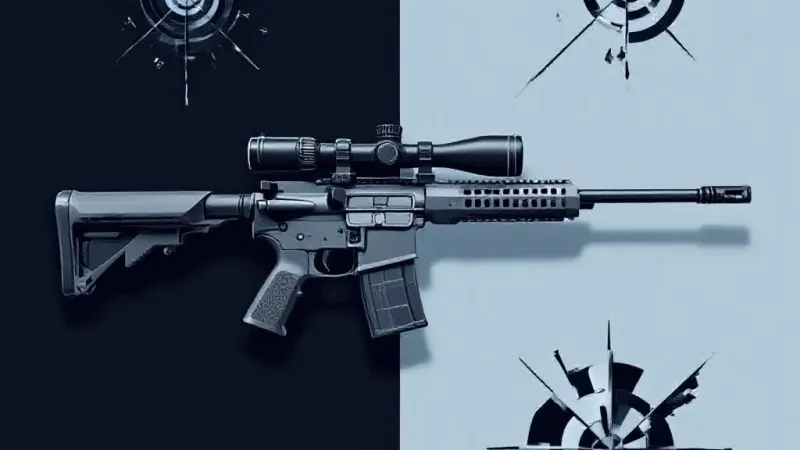
Competitive long-range precision shooting demands meticulous attention to ammunition consistency, favoring handloads or factory match offerings for their tight groups and reliable ballistic coefficients. However, a recent assessment revisited a foundational question for military sniper weapon systems: how does a rifle like the M24 perform when forced to rely on standard M80 ball ammunition? This inquiry moves beyond optimal match conditions, focusing on the rifle’s capability in dire resupply situations.
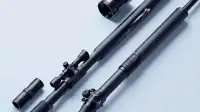
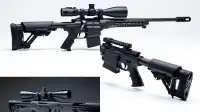
The test utilized a used M24 sniper rifle, equipped with its characteristic fixed 10X scope. Prior evaluations with match-grade ammunition demonstrated the rifle's inherent precision. Firing five-shot groups at 100 yards with Federal Gold Medal 175 Grain SMK ammunition, the rifle consistently achieved accuracy well under 1 MOA with factory loads, and even tighter 0.5 MOA groups with optimized handloads. This baseline established the M24’s potential with its intended specialized ammunition.
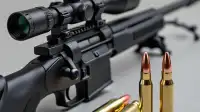
The focus then shifted to Winchester M80 147 grain full metal jacket ammunition, the standard US Military ball cartridge often seen in belt-fed systems like the M240G. Ten rounds of M80 were fired to determine accuracy and velocity. The results revealed a significant degradation in precision, with the M24 producing a 10-round group measuring 2.572 MOA. This figure starkly contrasts the sub-MOA performance achieved with match ammunition.
Chronograph data for the M80 ball ammunition showed an average muzzle velocity of 2,803 feet per second, accompanied by a standard deviation of 17.8. Notably, this measured velocity was within 3 feet per second of military specifications, indicating the ammunition itself performed consistently to its design parameters, despite the wider group dispersion.
Ballistic calculations compared the M80 147 FMJ (at 2,803 ft/s) against two common match loads: the 175 SMK (at 2,600 ft/s) and the 168 SMK (at 2,756 ft/s). While the lighter M80 round predictably did not fare as well as the heavier match projectiles in resisting wind drift, its trajectory exhibited similar bullet drop out to 1,000 yards. This comparable drop is attributed to the M80’s higher muzzle velocity, which helps compensate for its lighter mass over distance.
Ultimately, while 2.5 MOA accuracy falls short of competitive precision rifle standards, the data provides a valuable insight into the M24's fallback capability. In an emergency scenario where specialized match ammunition is unavailable, understanding the real-world performance with standard ball rounds offers critical context for engagement capabilities, proving that "it is better than nothing."