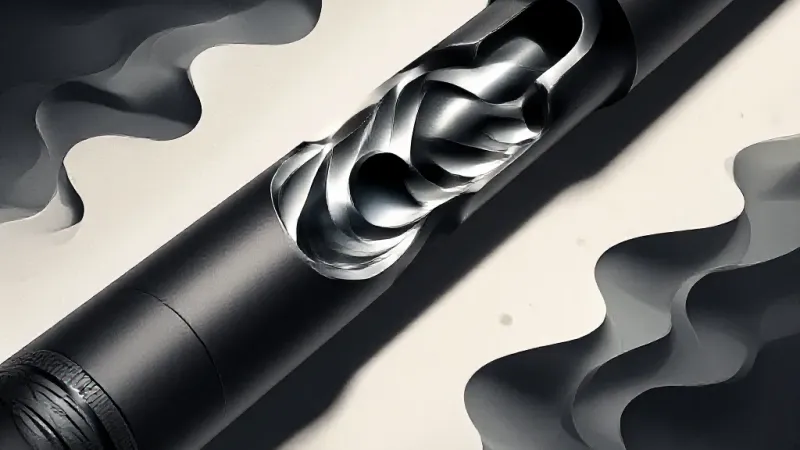
In the landscape of modern precision rifle shooting, the barrel stands as the critical component determining accuracy and consistency. While actions serve as the delivery mechanism, the barrel's engineering dictates the ultimate performance in competitive shooting, long-range hunting, and tactical applications.
Modern precision rifle barrels are engineered for extreme accuracy, consistency, and longevity. A critical factor in their performance is the rifling process, which creates helical grooves inside the barrel to impart spin on the bullet for stability. The three primary methods for rifling are cut rifling, button rifling, and cold hammer forging (CHF). These techniques differ significantly in their production processes, cost implications, the stress they induce on the metal, and the resulting characteristics of the barrel.
Precision barrels prioritize uniformity in bore dimensions, groove depth, and twist rate to minimize bullet deformation and maximize accuracy. Cut and button rifling are predominant in custom precision barrels, valued for their ability to produce tight tolerances. In contrast, cold hammer forging is more common in mass-produced or military-grade barrels, where durability is a key design consideration.
In precision contexts, cut rifling is often considered superior for ultimate accuracy due to its stress-free process and the exactness it allows in twist rates. However, button rifling has significantly narrowed this gap with the advent of modern techniques like vacuum stress relieving. While hammer forging excels in durability, it is less frequently found in boutique precision builds because of potential inconsistencies. Variations such as 5R rifling, which features sloped lands to reduce bullet deformation, can be applied to any method but are particularly popular in both cut and button barrels.
Based on competitive shooting data from PRS and NRL professionals, along with manufacturer specifications, the dominance of certain barrel types in specific applications becomes clear. Cut-rifled brands like Bartlein and Krieger are widely observed among top shooters in competitive circles like the Precision Rifle Series, with some data suggesting they are used by over 50% of leading competitors. Button-rifled options, including Lilja and Shilen, offer comparable performance at a lower cost.
Hammer-forged barrels, while highly durable, are less common in pure precision custom builds. They find their strength in robust factory rifles from makers such as Tikka or Ruger, where their endurance is a significant advantage. Ultimately, the choice of rifling method often comes down to a shooter’s priorities: cut rifling for maximum accuracy, button rifling for an excellent balance of value and performance, and cold hammer forging for robust endurance.
Beyond rifling, carbon-fiber barrels represent a significant innovation. Brands like Proof Research produce these barrels by combining a stainless-steel inner liner with an outer wrap of high-strength aerospace-grade carbon fiber impregnated with proprietary resin. This hybrid design addresses some limitations of traditional all-steel barrels, offering a balance of performance enhancements well-suited to modern firearms.
Carbon-fiber barrels excel in delivering lightweight, heat-resistant, and accurate performance. Their versatility makes them a premium choice for both professional and recreational shooting, particularly for shooters who prioritize mobility and precision, though they typically come at a higher cost than traditional steel options.