
For competitive long-range shooters, understanding the terminal performance of various ammunition types through a precision rifle is paramount. While most PRS and NRL competitors rely on meticulously handloaded match ammunition or premium factory offerings, an enduring question among enthusiasts has been the practical accuracy of military sniper systems when forced to rely on standard full metal jacket (FMJ) ball ammunition.
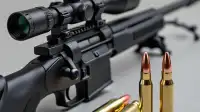
A recent examination focused on this very query, utilizing an M24 Sniper Rifle equipped with a fixed 10X scope to evaluate the rifle's performance with both match and M80 ball ammunition. The M24 platform, known for its precision with specialized loads, provided a baseline before transitioning to a more common military cartridge.
Initially, the M24 demonstrated excellent inherent accuracy with Federal Gold Medal 175 Grain SMK ammunition. Firing 5-shot groups at 100 yards, the rifle consistently achieved performance well under 1 MOA with this factory match ammunition. When using carefully developed handloads, the rifle's precision further tightened to an impressive .5 MOA, establishing a clear benchmark for its capabilities with optimal munitions.
The core of the evaluation then shifted to the M80 Winchester 147 grain full metal jacket ammunition, recognized as the standard U.S. Military ball cartridge often encountered in belt-fed systems like the M240G. Ten rounds of M80 were fired from the M24, yielding a reported accuracy of 2.572 MOA at 100 yards. This represents a significant degradation in precision compared to the rifle's performance with match-grade ammunition. While a decrease in accuracy was anticipated, the extent of the spread highlights the critical difference between purpose-built match projectiles and standard military ball.
Further data collected during the M80 firing revealed an average muzzle velocity of 2,803 feet per second, with a standard deviation (SD) of 17.8. This velocity was noted to be remarkably close to military specifications, differing by only 3 feet per second. However, for precision long-range engagement, an SD of 17.8 ft/s is a notable factor contributing to vertical dispersion, particularly as distance increases.
Ballistic analysis was then conducted, processing the M80 147 FMJ velocity data through a ballistic application. The M80's trajectory was compared against that of the 175 SMK (at 2,600 ft/s) and the 168 SMK (at 2,756 ft/s) out to 1,000 yards in 100-yard increments. Interestingly, despite its lighter mass, the M80's higher muzzle velocity resulted in a similar bullet drop profile to the heavier match rounds. This underscores how velocity can partially compensate for bullet weight in terms of vertical holdovers at certain ranges.
However, the ballistic comparison also highlighted the M80's lesser performance in crosswinds. The lighter, less aerodynamically efficient M80 projectile was observed to drift more significantly than the heavier, higher-BC match rounds. For precision shooters accustomed to meticulous wind calls and minimal deflection, this difference is substantial, drastically altering engagement solutions beyond close range.
The findings offer valuable insight for understanding the practical limitations of military sniper systems when specialized ammunition is unavailable. While a 2.5 MOA rifle is far from the sub-MOA precision demanded in competitive shooting, it represents a known capability in an emergency scenario. For competitors, this analysis reinforces the fundamental importance of consistent, high-BC match ammunition and low velocity standard deviations in achieving repeatable hits at extended ranges, especially when factoring in challenging wind conditions.