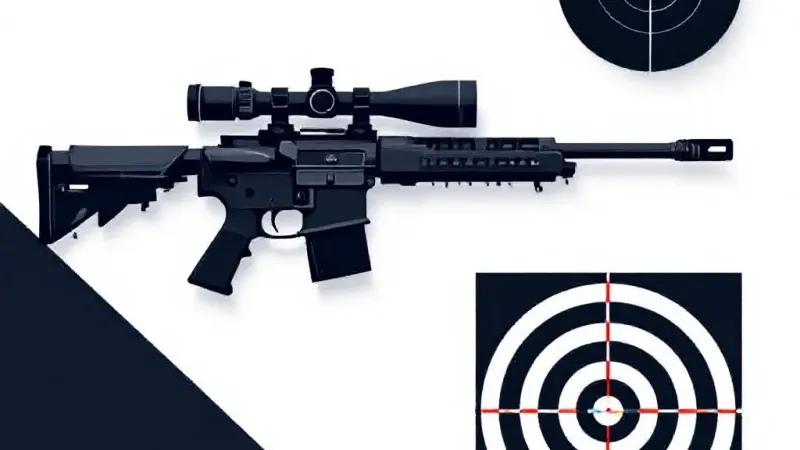
For the discerning precision rifleman, understanding ammunition performance is paramount, particularly when assessing a system's true capabilities. While military sniper rifles are engineered for optimal function with specialized match ammunition, the intriguing question of their accuracy with standard full metal jacket (FMJ) ball ammunition occasionally surfaces. According to a detailed report first published on rifleshooter.com, a test was conducted to definitively answer this for the iconic M24 Sniper Weapon System.
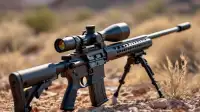
The test platform utilized was a seasoned, used M24 Sniper Rifle, fitted with its characteristic fixed 10x power optic. Prior to the ball ammunition evaluation, this specific M24 established a robust baseline of excellent mechanical accuracy with its intended match-grade loads. Firing 5-shot groups at 100 yards, the rifle consistently delivered sub-1 MOA performance with factory Federal Gold Medal 175 Grain Sierra MatchKing (SMK) ammunition. When loaded with carefully developed hand loads, its precision further tightened, reliably achieving outstanding .5 MOA groups, showcasing the platform's intrinsic capability.
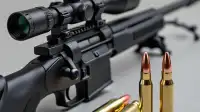
The crux of the evaluation, however, focused on the rifle’s performance with Winchester M80 147 grain FMJ ammunition – the widely adopted standard US Military ball cartridge found in numerous applications, including belt-fed systems like the M240G. After a series of ten test rounds, the accuracy results were unequivocal: the M24, with M80 ball, produced an average group size of 2.572 MOA. This represents a severe degradation in precision, falling far short of the rifle's match-grade capabilities and highlighting the profound impact of projectile design on downrange accuracy.
Further technical analysis of the M80 load revealed an average muzzle velocity of 2,803 feet per second, accompanied by a standard deviation (SD) of 17.8 feet per second across the ten shots. It was noted that this measured velocity was remarkably consistent with the military's specified velocity for M80, diverging by only 3 feet per second. This consistent velocity, however, could not overcome the inherent ballistic limitations of the FMJ projectile's design.
Ballistic modeling provided additional insights, comparing the M80's trajectory against established match rounds: the 175 grain SMK at 2,600 ft/s and the 168 grain SMK at 2,756 ft/s. While the lighter M80 projectile surprisingly demonstrated similar drop characteristics to the heavier match bullets out to 1,000 yards—a phenomenon likely attributed to its higher initial velocity compensating for a less aerodynamic form factor—its susceptibility to wind drift was significantly more pronounced. The report concludes that while 2.5 MOA accuracy is wholly unsuitable for competitive precision shooting or primary military sniping roles, it provides a measurable performance baseline for emergency resupply scenarios, albeit a compromise.