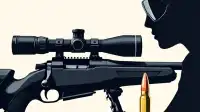
For competitive long-range shooters, every component in the system is meticulously chosen for its contribution to precision. We pour over concentricity, ES/SD, and BCs, ensuring our handloads deliver sub-MOA performance well past transonic. This fastidiousness naturally leads to questions about military sniper systems and their performance with standard-issue ammunition. Specifically, the M24 SWS, a platform revered for its precision heritage, often sparks curiosity regarding its accuracy when fed M80 Ball instead of its intended M118LR.
The M24 is built upon a robust Remington 700 long action, typically fitted with a 24-inch or 26-inch heavy contour barrel, commonly featuring a 1:11.25" twist rate. This twist is optimally designed to stabilize heavier, longer projectiles like the 175-grain Sierra MatchKing BTHP used in M118LR, enabling consistent sub-MOA performance at extended ranges, often tighter than 0.5 MOA with skilled marksmanship and ideal conditions. This is the precision benchmark we expect from such a purpose-built system.
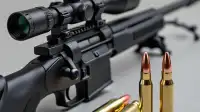
However, introducing M80 Ball ammunition dramatically alters the equation. M80, generally a 147-grain FMJ-BT, is manufactured for general-purpose machine gun and rifle use, prioritizing reliability and cost-effectiveness over surgical precision. Its construction is inherently inconsistent: open tips, variable jacket thickness, non-uniform core material, and less stringent quality control on propellant charges and bullet seating depth all contribute to significant shot-to-shot variability. These intrinsic manufacturing compromises manifest directly as increased group sizes and larger SD/ES numbers, even from a top-tier precision barrel.
Our experience and numerous tests consistently show that an M24, capable of grouping M118LR into half an inch at 100 yards, will struggle significantly with M80 Ball. Expect group sizes to expand to 2-3 MOA, sometimes even larger. This isn't a deficiency of the rifle itself, but a stark illustration of the principle that a precision rifle is only as accurate as the ammunition it's fed. The rifle's inherent capability to achieve tight harmonic nodes and minimal dispersion is utterly negated by the erratic ballistics and construction inconsistencies of M80, especially when factoring in spin drift and Coriolis effects over distance, which demand consistent BC values.
This real-world performance difference underscores a critical lesson for PRS and NRL competitors. While military sniper rifles are designed for robustness and operational effectiveness, their ultimate precision is intrinsically linked to the quality of their ammunition. Truing your DOPE, making accurate wind calls, and perfecting positional shooting techniques are all foundational, but they hinge on a consistent ballistic package that high-quality match ammunition provides. Understanding this fundamental relationship between bullet construction, twist rate optimization, and realized accuracy is paramount, whether you're engaging steel at 1000 yards or simply evaluating legacy platforms. The M24 with M80 Ball serves as a potent reminder that ammunition choice is not merely a preference, but a fundamental determinant of precision potential.