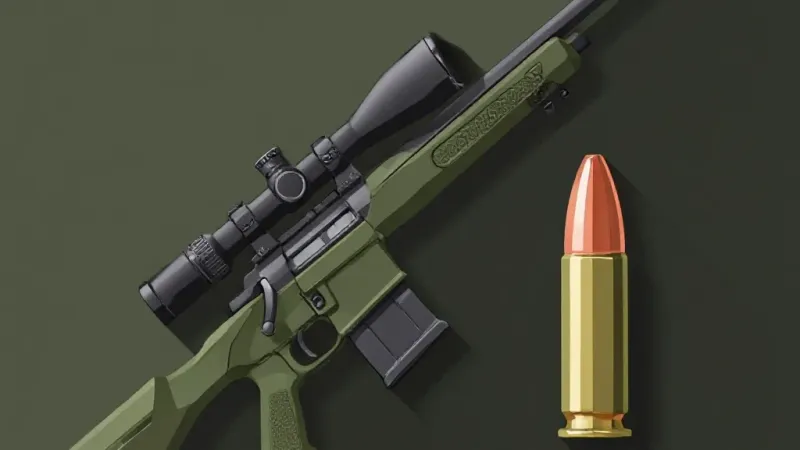
The M24 Sniper Weapon System, designed for precision engagement with specialized match ammunition, is a platform widely respected for its capabilities. However, a recent inquiry from rifleshooter.com addressed a long-standing question among military rifle enthusiasts and competitive shooters alike: how does the M24 perform with readily available standard ball ammunition, specifically the M80 147-grain full metal jacket (FMJ) common in systems like the M240G?
The test rifle was a used M24 fitted with a fixed 10X optic, a configuration familiar to many who’ve studied military sniper systems. Prior testing with Federal Gold Medal 175 Grain SMK ammunition established a baseline, demonstrating the rifle’s excellent inherent accuracy: groups consistently shot well under 1 MOA with factory match loads and tightened to an impressive .5 MOA with carefully crafted handloads. These benchmarks were achieved with 5-shot groups at 100 yards, reinforcing the M24’s reputation when paired with its intended precision ammunition.
For the ball ammunition segment, the tester utilized Winchester M80 147-grain FMJ. Ten rounds were fired to gauge performance. The results, as reported by rifleshooter.com, indicated a significant accuracy shift: the M24 produced 2.572 MOA groups with the M80 ball. This stark contrast highlights the critical difference between purpose-built match projectiles and general-issue ball ammunition in a precision rifle.
Chronograph data for the M80 ammunition showed an average muzzle velocity of 2,803 feet per second, with a standard deviation (SD) of 17.8. Notably, this velocity was remarkably close to military specifications, differing by only 3 feet per second. Ballistic application analysis further illustrated the M80’s trajectory compared to match loads, plotting it against a 175-grain SMK at 2,600 ft/s and a 168-grain SMK at 2,756 ft/s. While the M80’s higher velocity contributed to similar bullet drop profiles at extended ranges despite its lighter mass, its performance in wind deflection was demonstrably inferior to the heavier, higher-BC match projectiles.
While 2.5 MOA is a substantial degradation from sub-MOA precision, the assessment concludes that, in a dire resupply scenario, such performance is 'better than nothing.' This test offers a practical look into a niche performance metric, underscoring the specialized role of match ammunition in achieving the M24’s full long-range precision potential, a lesson well understood by the competitive precision rifle community.