
While our typical focus at ColdBore centers on the bleeding edge of competitive long-range precision, the fundamental principles governing rifle accuracy and ballistic performance remain universal, regardless of platform. This week, we pivot briefly to examine a common gunsmithing operation applied to a more traditional rifle system: the cutting and re-crowning of a Winchester 94 in .30-30. The insights gained from precise barrel work are critical for any shooter, from PRS stages to the deer woods.
The decision to shorten a barrel often stems from practical considerations like balance, maneuverability, or aesthetics. However, simply hacking off a section is detrimental to accuracy. The muzzle crown is, without hyperbole, one of the most critical elements dictating a rifle's intrinsic precision. As the projectile exits the bore, the crown ensures uniform gas expansion and separation from the bullet's base. Any imperfection – a burr, an uneven cut, or a ding – will cause asymmetrical gas pressure, tilting the bullet even microscopically and introducing significant yaw downrange. For a rifle intended to hold sub-MOA at 1000 yards, a compromised crown is a non-starter. For any rifle, it degrades consistency.
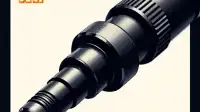
Executing a proper crown typically involves skilled lathe work, ensuring the bore axis is perfectly aligned with the cutting tool. Common crown types include the recessed 11-degree target crown, popular for its robust protection and proven performance, or a simple 90-degree chamfer. The goal is always a clean, concentric cut that leaves the rifling lands undisturbed and equal at the muzzle. A thorough concentricity check post-crowning is non-negotiable.
Beyond the physical cut, shortening a barrel inherently alters a rifle's ballistic profile. Reducing barrel length directly translates to a loss in muzzle velocity, which for a .30-30, while not typically stretching targets to a mile, still impacts trajectory and terminal performance. Chronographing pre- and post-modification is paramount. Understanding this velocity shift requires recalculating your ballistic data, even for a lever gun's typical engagement distances. Every 25-50 FPS loss can equate to tangible drops at extended ranges, necessitating a revised DOPE. This reinforces the necessity of trued data, whether for a 6 Dasher sending Berger 105 Hybrids or a .30-30 delivering a flat-nose lead round.
Barrel harmonics also shift with length. While not typically 'tuned' for precision nodes on a lever action in the same way we might experiment with load development for a competitive bolt gun, the underlying physics applies. The new length will resonate differently, potentially affecting point of impact. Cold bore shots might show a different POI relationship than before, demanding re-validation.
In essence, whether it’s a custom PRS build or a classic Winchester, the meticulous attention to barrel geometry and the subsequent re-evaluation of ballistic performance underscores the universal pursuit of precision. The tools and techniques employed by a skilled gunsmith for a lever gun are often the same foundational practices applied to extract maximum accuracy from any rifle system. Understanding these principles is key to maximizing performance across all platforms.