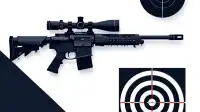
While the Ruger Mini-14 is celebrated for its rugged reliability and classic aesthetic, it has never been a contender in the arena of precision rifle competition. Its design, rooted in military utility rather than benchrest accuracy, presents inherent challenges for those accustomed to sub-MOA performance. Yet, for the discerning shooter who enjoys a technical challenge, optimizing a Mini-14 for its maximum practical precision offers a fascinating academic exercise in applied ballistics and rifle dynamics.
The primary hurdle for the Mini-14 is its slender, tapering barrel. Prone to significant point of impact (POI) shift as it heats, this characteristic makes consistent grouping beyond a few shots a test of patience. Solutions often begin with addressing barrel harmonics. Aftermarket barrel struts, such as those from Accu-Strut or Mo-Rod, effectively stiffen the barrel, mitigating flex and dampening oscillations. While not transforming it into a heavy target contour, these devices demonstrably reduce group size and slow thermal POI migration. For the truly committed, a custom re-barrel to a heavier profile by a skilled smith is the ultimate, albeit costly, path to enhanced stability.
Beyond the barrel, the action's interface with the stock is critical. Factory Mini-14 stocks offer minimal support, contributing to inconsistent shot-to-shot performance. Upgrading to a more rigid aftermarket stock, perhaps a robust synthetic or an aluminum chassis system (though often overkill for pure accuracy, it illustrates the concept), provides a more stable bedding platform. Proper bedding, even on a gas-operated semi-automatic, minimizes movement and stress points on the receiver, allowing the rifle to return to battery more consistently and predictably.
Trigger quality is another bottleneck. The factory Mini-14 trigger is typically heavy and gritty, hindering precise shot placement. A competent trigger job to achieve a crisp, predictable break in the 3.5 to 4.5-pound range significantly reduces shooter-induced error. This focus on a clean trigger pull is paramount, irrespective of the platform's inherent accuracy potential, as it directly impacts one's ability to maximize group potential. Finally, stable optic mounting is non-negotiable. Robust, properly torqued rings on a solid base that resists movement from the reciprocating action are essential for maintaining zero and ensuring repeatable performance.
Ammunition selection and handloading are where the precision shooter's expertise truly shines. Developing loads for optimal velocity nodes, aiming for minimal SD and ES, is crucial. While the Mini-14 may not exploit the extreme BCs of VLD projectiles as effectively as a dedicated precision rifle, selecting consistent, high-quality components and tuning for concentricity and charge weight uniformity will yield the tightest possible groups from the platform. Truing data for even moderate distances becomes a valuable exercise in understanding the rifle's ballistic signature, rather than relying solely on generic ballistic calculators.