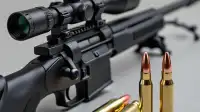
The M24 Sniper Weapon System, a cornerstone of military precision marksmanship for decades, was engineered from the ground up to deliver uncompromising accuracy with match-grade ammunition like M118LR. Built on the venerable Remington 700 long action, featuring a 24-inch, 1:11.25 twist heavy contour barrel, and bedded into a McMillan A2/A3 stock, its design intent was clear: repeatable sub-MOA performance. However, a question often surfaces among enthusiasts and competitive shooters alike: how does this dedicated precision platform fare when fed standard military M80 Ball ammunition? The answer, while perhaps predictable, warrants a closer technical examination.
M80 Ball, designated as a 7.62x51mm NATO cartridge, is produced to meet a specific combat reliability standard, not an inherent precision threshold. Its 147-grain full metal jacket (FMJ) boat-tail projectile typically exhibits significant manufacturing variance in concentricity, jacket uniformity, and meplat consistency. Compared to the Open Tip Match (OTM) projectiles found in M118LR, these inconsistencies translate directly into a wider dispersion of ballistic coefficients (BCs) and less predictable flight characteristics, especially beyond 300 yards. Furthermore, the propellant charges in M80 are not held to the tight standard deviations (SD) and extreme spreads (ES) seen in match-grade loads, leading to notable velocity variations that confound holdovers and wind calls.
Empirical testing with M80 Ball through a properly maintained M24 typically shows group sizes dramatically open up compared to its match-ammo potential. While M118LR reliably delivers 0.75-1.0 MOA at 100 yards, M80 Ball usually struggles to maintain anything better than 2.0-3.0 MOA. This isn't a defect of the M24 system; rather, it highlights the fundamental principle that a rifle system is only as accurate as the ammunition it fires. The M24's robust action, free-floated barrel, and rigid stock certainly provide a stable launch platform, minimizing external factors that could exacerbate poor ammunition quality. Yet, even the finest precision rifle cannot fundamentally correct for inconsistent bullet weight, irregular jackets, or disparate muzzle velocities.
For practical purposes, this means while M80 Ball might cycle reliably and provide acceptable accuracy for close-range training or general plinking, it completely undermines the M24's inherent precision capabilities. Engaging man-sized targets reliably past 500-600 yards becomes a gamble, not a calculated shot, due to the widening cone of fire and unpredictable trajectory shifts. For those pursuing PRS or NRL disciplines, where first-round hits on demanding steel at extended ranges are paramount, such ammunition would be a non-starter. Understanding these limitations is critical for anyone operating a precision rifle, reinforcing why handloaders meticulously sort components and factory match ammunition commands a premium. The M24 is a race car; M80 Ball is regular pump gas. It might run, but don't expect it to set any lap records.